Great Race era (about 150 million years ago)
The Colour Out of SpaceThe Great Race era (about 150 million years ago) is the deep-prehistoric world reconstructed from Nathaniel Wingate Peaslee’s dreams, research, and expedition to ancient ruins in Western Australia. It is presented as the age of the Great Race of Yith, whose mastery of mind projection and preservation of knowledge made it possible to study earthly history across spans far beyond human experience. Yet its apparent traces reach the reader through incomplete memories and uncertain material evidence, so the era remains both an immense imagined history and a possibility the narrative cannot conclusively prove.
Chronology and Deep-Time Setting
Peaslee’s account places the dream-period somewhat less than 150 million years ago, as the Palaeozoic gave way to the Mesozoic. Its scale unsettles any history centred on humanity: the myths and impressions associated with the Great Race of Yith describe dominant species before the first amphibian ancestor of humanity emerged from the sea, and imagine successive forms of life extending across millions or even billions of years. The Great Race is said to have endured until roughly fifty million years before humanity’s advent. These are not dates established by a continuous human record; they belong to a reconstruction assembled from remembered dreams, legends, and research.
In this account, time is not merely a sequence of events inaccessible to later generations. The Great Race of Yith could project its minds into the past and future, seeking knowledge from other periods and life-forms. The race’s particular distinction was its ability to master this temporal reach and gather knowledge of what had been and what would come. Its history therefore makes human chronology seem less like the measure of the past than one brief layer within a much longer succession.
The Great Race and Its Records
The bodies Peaslee associates with the Great Race of Yith were of a specialized organic form, neither clearly animal nor vegetable. Their cell activity almost eliminated fatigue and the need for sleep; their nourishment was semi-fluid, and they had three eyes and senses that humans could not readily understand. They had no sex and reproduced through seeds or spores that developed underwater. Individuals commonly lived for four or five thousand years. These details come from scattered dream fragments and research rather than a complete account of daily life, which Peaslee acknowledges remained obscure.
The civilization’s knowledge was gathered in vast libraries. Its records covered the histories, languages, arts, achievements, and psychologies of species that had existed or would exist on Earth. Books were made from durable cellulose sheets, bound in cases of light, rustless metal and stored in ordered vaults. Peaslee’s account places his own history in the archive’s vertebrate level, among records concerning humanity and the furry and reptilian races that preceded it in terrestrial dominance. The archive turns the Great Race’s command of time into a material system: far-reaching knowledge is collected, classified, and preserved for future use.
That system also controlled what could survive in the minds of its visitors. When a displaced mind returned to its own body and age, mechanical hypnosis erased most of what it had learned in the Great Race’s era. The account attributes this policy to the dangerous consequences of transmitting large quantities of future knowledge. Usually, only a dreamlike blank or fragments of memory remained. Rarely, fragments joined or persisted strongly enough to pass hints of the forbidden past into later times, helping to form myths about the Great Race. Peaslee’s own reading of early tales during his period of amnesia may likewise have shaped the pseudo-memories he later experienced, making the origin of his knowledge difficult to separate from its apparent confirmation.
Conflict and the Buried Past
The Great Race of Yith is also placed within a history of earlier and continuing threats. According to the reconstructed account, its minds came from Yith, an obscure world beyond the galaxy, and entered the cone-shaped beings that inhabited Earth. The beings they displaced were left to die in unfamiliar forms. On Earth, the Great Race subdued an older race that had built basalt cities and driven it into the caverns below the surface, sealing passages to contain it. Later irruptions from the inner world led the Great Race to close more routes and guard the remaining ones. This history makes the civilization’s achievement inseparable from its vigilance: its archives preserve knowledge, but its sealed passages register dangers it could not simply erase.
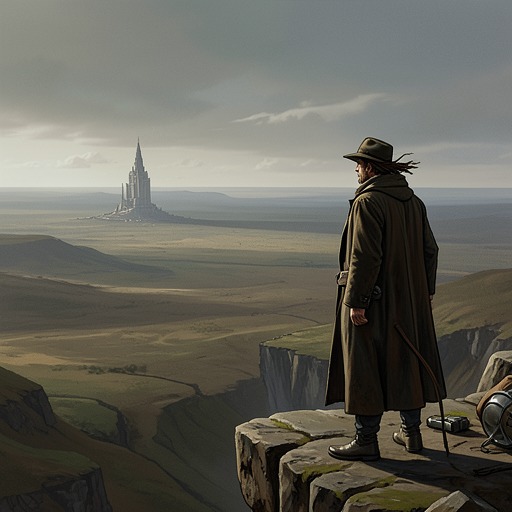
The surface remains attributed to this remote past were fragmentary. In 1935, an expedition in Western Australia reached half-buried blocks that matched the masonry Peaslee associated with his dreams. A month of excavation produced about 1,250 blocks: mostly carved megaliths with curved tops and bottoms, alongside flatter floor-like stones and massive pieces suggestive of arches or vaulting. Their scattered condition offered no clear plan of the original structures. Water-worn surfaces and geological changes pointed to an immense antiquity, while the blocks’ displacement made the passage of time visible as upheaval rather than as an orderly human chronology.
The Archive and the Problem of Proof
In the buried ruins, Peaslee eventually reached a circular crypt and familiar, hieroglyph-covered corridors leading to an enormous archive. Metal shelf-doors remained in place in some vaults; others had sprung open or buckled under geological pressure, and fallen cases lay beneath empty shelves. He found a book in a rustless metal case and recognized its unfamiliar writing as the language of a captive mind from an asteroid. The archive’s contents, in his experience, extended beyond terrestrial history to records of non-terrestrial worlds as well.
The decisive discovery was not an alien script but a familiar one. In another book, among the deep-time records, Peaslee saw English words written in his own handwriting. The pages appeared to place his personal record in a repository untouched since before humanity appeared on Earth, binding the modern investigator to the ancient archive he had imagined. But the evidence remained incomplete: he did not bring back the metal case, and the underground corridors had not been found. The Great Race era thus ends for the reader at a threshold between extraordinary confirmation and possible dream. Its buried records suggest that human life is only one episode in a vast planetary history, while their failure to survive as verifiable evidence leaves that history unresolved.